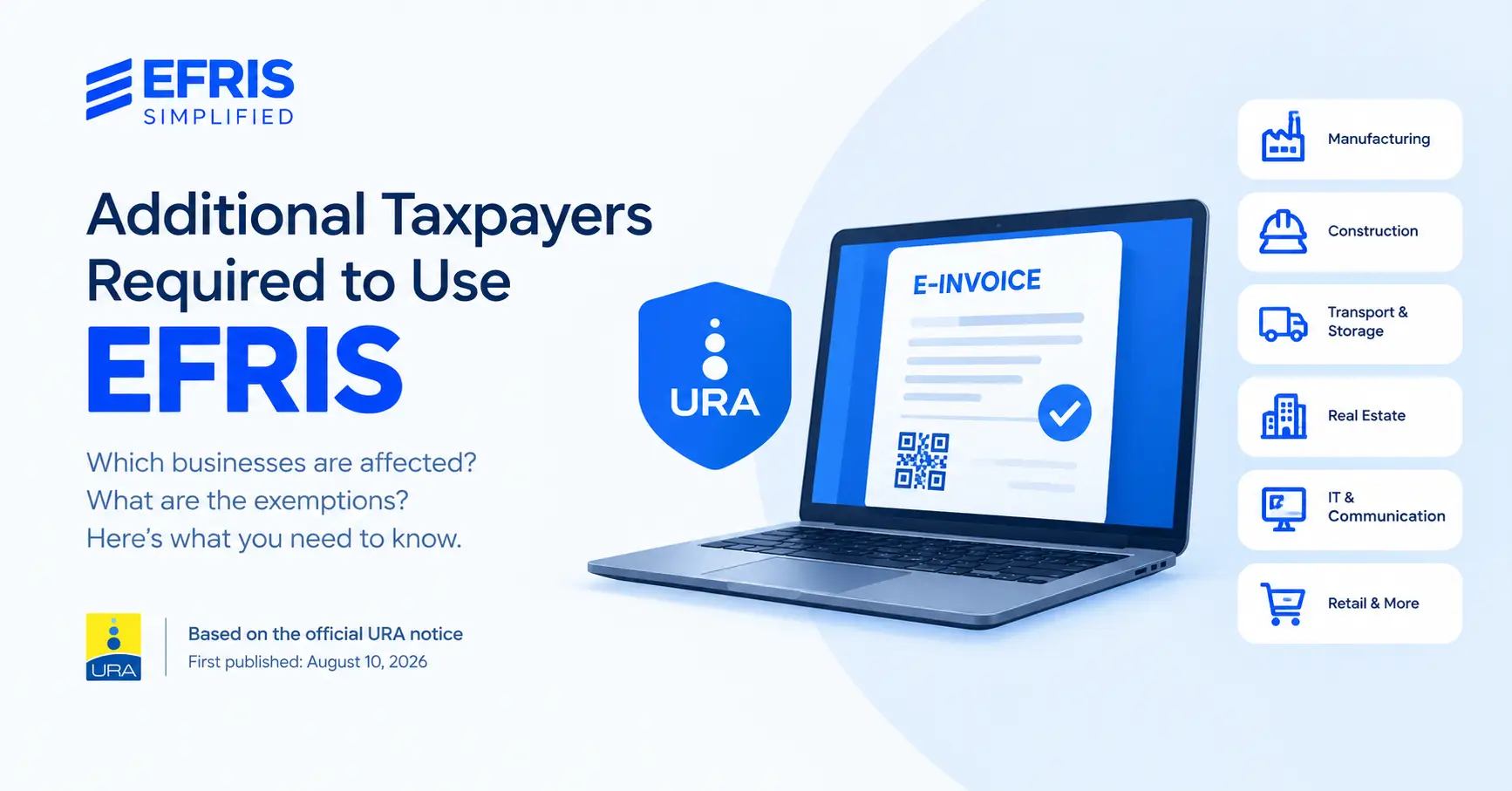
URA has expanded the EFRIS requirement in Uganda to additional business sectors, including manufacturing, construction, transport, real estate, IT, retail, accommodation and more. Learn which businesses must use EFRIS, the exemptions, turnover thresholds, and what the new EFRIS requirements mean for taxpayers.
The Uganda Revenue Authority (URA) has expanded the categories of businesses required to use the Electronic Fiscal Receipting and Invoicing Solution (EFRIS).
According to an official URA notice first published on August 10, 2026, businesses operating in specific sectors are required to use EFRIS to issue electronic invoices and electronic receipts.
This requirement is in addition to the existing mandatory EFRIS requirement for all VAT-registered taxpayers.
The expanded requirement took effect on July 1, 2025.
Official source: Uganda Revenue Authority (URA), Additional Taxpayers Required to Use EFRIS, first published August 10, 2026.
URA identifies the following sectors as being covered by the expanded EFRIS requirement.
This covers businesses involved in the physical or chemical transformation of raw materials or intermediate goods into new products.
Examples may include businesses that manufacture or process products from raw materials.
This sector covers the extraction of naturally occurring minerals in solid, liquid, or gaseous form.
Extraction activities can be carried out through different methods, including:
This includes businesses involved in water supply and activities related to the management of different forms of waste.
The sector includes the collection, treatment, and disposal of:
This covers activities involving the provision of electric power, natural gas and similar services through networks such as power lines, pipelines and other distribution systems.
The construction sector includes general and specialized construction activities involving buildings and civil engineering works.
It covers activities such as:
This includes the provision of passenger or freight transportation, whether scheduled or unscheduled, by:
It also covers related activities such as:
URA specifically states that, for this phase of the EFRIS rollout, providers of passenger land transport are not required to use EFRIS.
This includes:
This sector covers businesses providing short-stay accommodation to visitors and travelers, as well as businesses providing complete meals and drinks intended for immediate consumption.
This includes accommodation and food service businesses such as hotels, lodges, restaurants and similar establishments.
This sector includes activities involving the production and distribution of information and cultural products, as well as the provision of means for transmitting or distributing those products.
It also covers:
URA states that non-resident digital service providers who are required to pay Digital Service Tax are not mandated to use EFRIS under this phase of the rollout.
This covers businesses and individuals acting as lessors, agents and/or brokers in activities involving:
This sector covers specialized professional, scientific and technical activities.
According to URA, these activities generally require a high degree of training and involve making specialized knowledge and skills available to users.
This includes a broad range of activities serving cultural, entertainment and recreational interests.
Examples include:
This covers fuel stations supplying kerosene and/or automotive fuels such as:
Although the above sectors are covered by the expanded EFRIS requirement, URA has specified certain exceptions.
Small businesses operating in the listed sectors with annual sales turnover of less than UGX 10,000,000 are not required to issue e-invoices or e-receipts through EFRIS.
However, these businesses may use EFRIS voluntarily.
Taxpayers earning rental income of less than UGX 2,820,000 annually are also not required to issue e-invoices or e-receipts through EFRIS.
Again, voluntary use of EFRIS is permitted.
The expansion means that EFRIS is no longer an issue limited to VAT-registered businesses.
Businesses operating in the sectors listed by URA need to determine whether the EFRIS requirement applies to them based on their sector and circumstances.
If your business is required to use EFRIS, your business transactions need to be supported by the appropriate electronic invoices or electronic receipts.
This is particularly important because EFRIS compliance can affect not only the process of issuing invoices, but also the tax treatment of business expenses.
URA also highlights an important tax implication.
Under Section 22(3)(m) of the Income Tax Act, no income tax deduction is allowed for an expense that is not supported by an e-invoice or e-receipt where the supplier is required to use EFRIS.
In practical terms, businesses should pay attention to whether suppliers are required to use EFRIS and ensure that qualifying business purchases are properly supported by EFRIS documentation.
URA further states that e-invoices and e-receipts issued for business purposes should contain the buyer's identification details.
These may include the buyer's:
Businesses should therefore provide the appropriate identification information when making purchases that require an EFRIS invoice or receipt.
URA provides different EFRIS platforms and usage resources to help taxpayers comply with the system.
Businesses that fall under the EFRIS requirement should first establish their compliance obligation and then choose an appropriate way of issuing their electronic invoices and receipts.
For businesses that already use accounting software, ERP systems, POS systems or custom business applications, EFRIS can also be integrated into existing workflows rather than requiring staff to manually enter every transaction.
This can be particularly useful for businesses processing a high volume of invoices or receipts.
If your business already uses accounting software, ERP software, a POS system or custom software, EFRIS Simplified provides an integration layer that can connect your existing business system to URA EFRIS.
The goal is to reduce the need for duplicate data entry and allow businesses to continue using the software they already rely on while handling EFRIS requirements through an integration.
EFRIS Simplified supports businesses that want to connect their existing systems to EFRIS without having to build and maintain the entire EFRIS integration themselves.
EFRIS requirements can depend on your taxpayer status, business sector and applicable exemptions.
The information in this article is based on the Uganda Revenue Authority's official notice, "Additional Taxpayers Required to Use EFRIS," first published on August 10, 2026.
For the most current requirements, taxpayers should verify their position directly with URA.
URA provides the following official contacts for EFRIS-related assistance:
Toll-free: 0800117000
Telephone: 0417 444 602
Email: services@ura.go.ug
WhatsApp: 0772 140 000
You can also access EFRIS registration information, available platforms and usage guidelines through the official Uganda Revenue Authority portal.
Uganda Revenue Authority (URA)
Additional Taxpayers Required to Use EFRIS
First published: August 10, 2026
This article is an explanatory adaptation of information published by URA. For authoritative and up-to-date guidance on EFRIS obligations, taxpayers should refer to URA directly.
Share this article